
9 Ways to Use AI in Marketing for Better Results
- 1. 9 Ways to Use AI in Marketing for Better Results
- 2. What does artificial intelligence (AI) mean?
- 3. How Does AI Work?
- 4. How does AI marketing operate?
- 5. how ai helps in marketing :
- 6. 1. Personalized Marketing
- 7. 2. Social Media Listening
- 8. 3. Email Marketing
- 9. 4. AI Chatbots and Virtual Assistants
- 10. 5. AI Content Creation
- 11. 6. Social Media Automation
- 12. 7. AI Ad Targeting and Optimization
- 13. 8. Sentiment Assessment
- 14. 9. SEO Improvement
- 15. AI Marketing Statistics
- 16. how is ai changing digital marketing (statistics)
- 17. What is Pros and Cons of Using AI Marketing ?
- 18. Pros
- 19. Cons
- 20. Discover how to use ai in marketing (ai tools )
- 21. What types of AI marketing tools do you use professionally?
- 22. Which AI tools are you familiar with ?
- 23. Top AI Tools using in Marketing
- 24. Automation Marketing tools
- 25. SEO Tools
- 26. Content creation tools
- 27. 14 Companies using ai Marketing (case studies) :
- 28. 1. The Economist
- 29. 2. Mastercard
- 30. 3. PayPal
- 31. 4. Netflix
- 32. 5. Amazon
- 33. 6. Tesla
- 34. 7. HubSpot
- 35. 8. Nike
- 36. 9. Spotify
- 37. 10. Sephora
- 38. 11. Zara
- 39. 12. EasyJet
- 40. 13. ClickUp
- 41. 14. Coca-Cola
What does artificial intelligence (AI) mean?
When discussing the use of artificial intelligence in marketing, we have to define ai first. Before we dive deeper, it’s essential to understand what AI is.
- Artificial Intelligence (AI) refers to the capability of machines to mimic human thinking and literacy processes. Rather than just following instructions, AI-driven technology can analyze data, find patterns, and make decisions by itself.
- AI performs tasks that normally require human thinking, such as solving problems and learning from experience
- AI makes tasks in healthcare and marketing faster and gives helpful information, so work is easier and more precise.
How Does AI Work?
Think of this example:
- To build an AI that suggests movies, first collect user ratings. The AI analyzes these ratings to recommend movies that align with user preferences.
- After training, the system can offer movie suggestions tailored to a user’s favorite genres or titles.
- As users give more feedback, the AI’s suggestions get better and more tailored.

How does AI marketing operate?
AI is transforming marketing practices by leveraging customer data to create highly personalized experiences, analyze market trends, and automate routine marketing tasks.
Using advanced data insights like predictive analytics, AI guides marketers to improve the relevance of their campaigns and content.

how ai helps in marketing :
AI helps marketers improve SEO, create content faster, and personalize campaigns. For a real example in the healthcare industry, explore these 12 Powerful Dental Clinic Digital Marketing Strategies designed to attract more patients and grow clinic visibility.
1. Personalized Marketing
AI looks through large amounts of consumer data to help marketers create hyper-personalized campaigns. By understanding customer behavior, preferences, and purchase history, ai marketing tools can craft tailored marketing messages, significantly increasing engagement and boosting conversion rates.

2. Social Media Listening
AI marketing-driven algorithms employ aspect-based clustering to analyze vast amounts of data in real-time.
AI studies social media data to help marketers understand customer feelings and trends. This helps brands better understand audience reactions and adjust strategies accordingly.
3. Email Marketing
Email marketing continues to be a key tool for engaging customers and converting leads. AI enhances email campaigns by analyzing performance metrics to improve strategy, such as identifying effective subject lines. It enables marketers to automate workflows based on user actions, analyze campaigns, and customize content for different audience segments.
AI also supports dynamic content generation, A/B testing, and refining email lists by evaluating their value. Additionally, AI tracks the effectiveness of email schedules to optimize timing.
According to Selzy, 63% of users trust AI email tools but still double-check, while 25% use AI emails without checking.
4. AI Chatbots and Virtual Assistants
AI marketing-powered chatbots provide round-the-clock customer support, handling queries and offering recommendations instantly. These bots manage multiple conversations simultaneously, guiding users through inquiries, recommending products, and improving the overall customer experience.

5. AI Content Creation
Natural Language Processing (NLP) enables AI to generate content such as blog posts, social media updates, and product descriptions. This automation saves marketers time and keeps the content style consistent.
Marketers use tools like Sprout to study what customers say online, making sure their content matches what people want.
6. Social Media Automation
AI can schedule social media posts at the best times and sort messages for you.
This leads to increased working efficiency and a more consistent brand voice. Features like suggested replies allow customer service teams to reduce response times, offering a quicker, more unified customer experience.
7. AI Ad Targeting and Optimization
AI algorithms refine ad targeting by analyzing user behavior and preferences. This helps ads reach the right people and makes your budget go further.
AI can also adjust bidding strategies and targeting in real-time to improve return on investment (ROI).
In fact, 65% of companies have reported better SEO results using AI tools. These tools help with precise keyword optimization, more relevant content, and even technical search engine optimization improvements
8. Sentiment Assessment
By analyzing online conversations and social media, ai marketing can gauge public sentiment toward a brand. This allows marketers to respond proactively, adapting messaging or addressing concerns as they arise.
9. SEO Improvement
AI’s SEO applications include automatically suggesting improvements, identifying SEO gaps, and offering insights into competitor strategies. 65% of companies had better SEO results when using ai marketing. AI tools help pick better keywords, create more relevant SEO content, and give technical tips.
We show companies how to use AI for better marketing results at Media A La Carte
AI Marketing Statistics
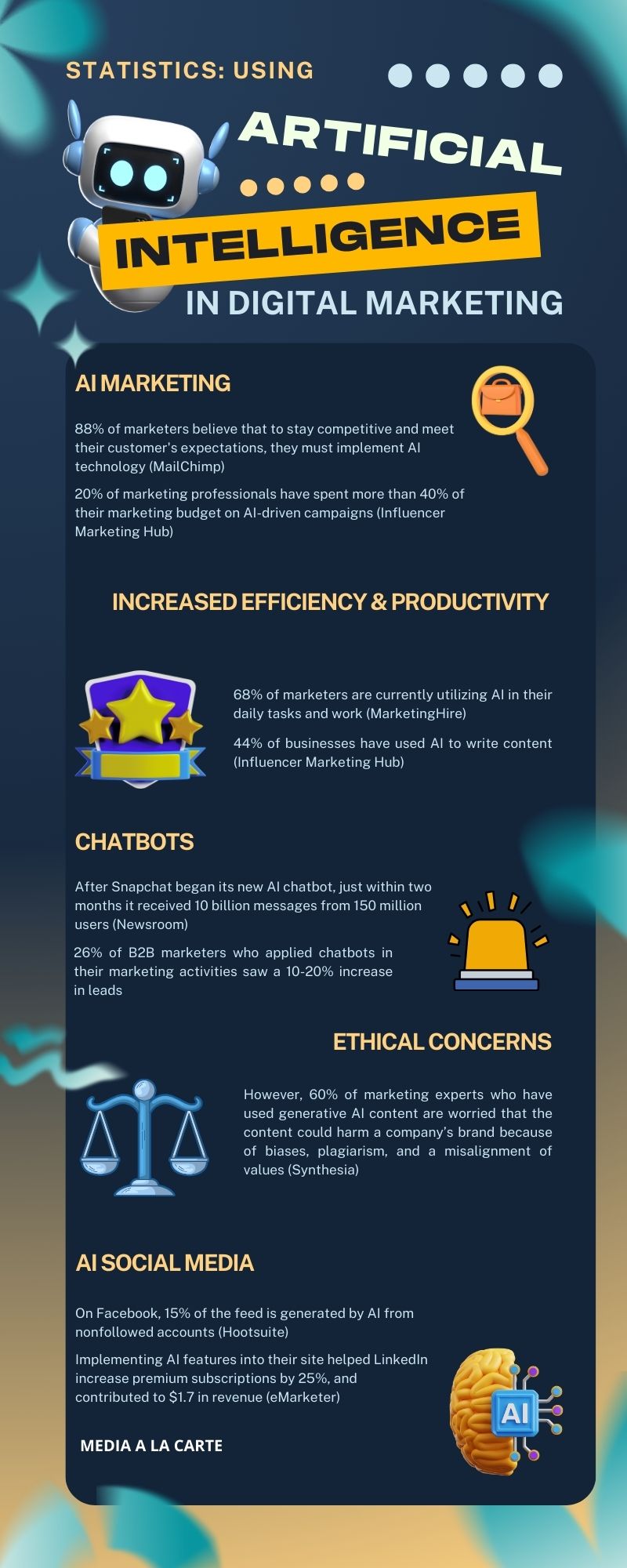
how is ai changing digital marketing (statistics)
What is Pros and Cons of Using AI Marketing ?
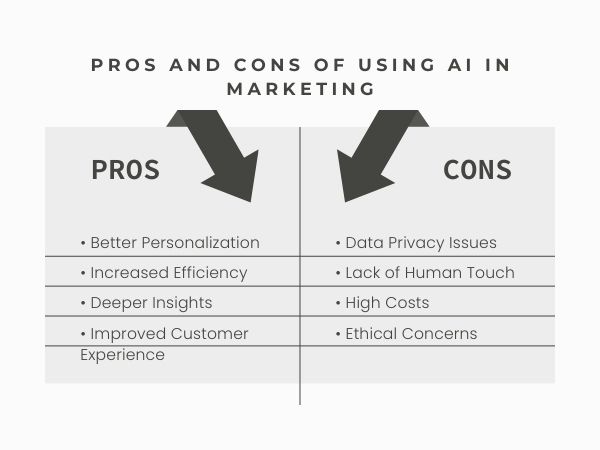
Pros
- Better Personalization: AI customizes marketing messages for each customer, improving engagement.
- Increased Efficiency: AI marketing handles repetitive tasks such as data processing, allowing marketers to focus more on creative work.
- Deeper Insights: AI marketing uncovers customer trends that humans might miss, which makes strategies more effective.
- Improved Customer Experience: ai marketing – chatbots provide fast, high quality, tailored support, enhancing customer satisfaction.
Cons
- Data Privacy Issues: AI marketing needs lots of user data, which raises privacy concerns.
- Lack of Human Touch: ai marketing can miss the emotional connection that comes from human interactions.
- High Costs: Implementing ai marketing can be expensive and requires skilled personnel.
- Ethical issues: AI systems can exhibit biases, often reflecting the way developers have trained them, which raises ethical issues.
Discover how to use ai in marketing (ai tools )
Foundation Inc. found that more than 300 marketers use AI tools every day to work better. When asked about automation tools, several platforms were highlighted:
What types of AI marketing tools do you use professionally?
The Result was:
- 87% : Content Creation
- 42% : Keyword Research
- 39% : Social Media
- 39% : Email Marketing
- 36% : Note Taking
Which AI tools are you familiar with ?
- 99.65% : ChatGPT
- Above 80% : Canva, Grammarly
- Above 60% : Midjourney, Dall-E, Jasper
- Above 40% : Copy AI
Top AI Tools using in Marketing
Automation Marketing tools
SEO Tools
Content creation tools

14 Companies using ai Marketing (case studies) :
1. The Economist
- In 2017, The Economist faced a declining audience but overcame this challenge by leveraging ai marketing for programmatic advertising. This technology allowed for the automatic purchase and sale of ads targeted at specific audience segments.
- By analyzing web and app usage data, The Economist identified unwilling readers and created targeted campaigns to reach them. They found new groups of readers by matching data, which brought in 3.6 million new users.
- This plan gave a 10-to-1 return and added 90,000 new subscribers in a year.
2. Mastercard
- Mastercard’s “Digital Engine” helps their team respond quickly to trends online.
- The tool tracks billions of online chats and spots trends in real-time, like travel and entertainment. When a relevant trend is detected,
- The team gets alerts about trends early, so they can post and advertise before everyone else.
- The tool worked well in Singapore, so they used it worldwide, boosting engagement and saving money
3. PayPal
- Previously, PayPal only reviewed inactive users at specific intervals, which slowed their ability to re-engage customers.
- They used an EDA model to watch for customer loss early, checking data all the time.
- This enables PayPal’s marketing team to take swift action with personalized, targeted outreach.
- Sixty percent of experts believe that biased or copied AI content might damage brands.
4. Netflix
- Netflix relies on AI to drive its recommendation engine.
- The system looks at what users watch and suggests shows they’ll like, keeping people engaged.
- Over 80% of the content viewed on Netflix comes from personalized recommendations, indicating their effectiveness.
5. Amazon
- Amazon leverages AI for its product recommendation tools, such as the “Customers Who Bought This Also Bought” feature.
- These suggestions come from AI studying what you look at and purchase, making shopping easier.
6. Tesla
- Tesla uses AI to analyze car data and is building a robot called Optimus for many tasks. Their cars use AI and cameras to spot roads and obstacles in real time.
7. HubSpot
- HubSpot, a trusted authority in digital marketing, is using ai marketing in various parts of its marketing strategy.
- AI helps quickly find topics, make article outlines, and speed up brainstorming.
- They use AI to make content like meta tags and video info, helping their marketing team.
8. Nike
- Nike leverages ai marketing in its digital marketing strategies to craft emotionally engaging advertisements. By analyzing the emotional characteristics of its target audience, the brand creates ad campaigns that deeply resonate with consumers.
- Using AI helped boost interest in Serena Williams’ launch and women in sports campaigns.
- Mixing AI insights with stories has helped Nike make more money and build its brand
9. Spotify
- Spotify uses AI to make custom playlists, giving users a unique music experience.
- In addition to its popular AI DJ feature, Spotify uses predictive algorithms to map and anticipate customer preferences.
- This system improves song picks and helps Spotify get more paid users—now 226 million.
10. Sephora
- Sephora’s app uses AI and AR so customers can try makeup virtually before buying.
- The tool offers a color match assistant and personal tips, helping Sephora create a custom shopping experience
11. Zara
- Zara works with tech companies to use AI in everything from supply chains to customer service.
- One of its partner, Jetlore, helps personalize shopping by analyzing customer preferences for style, color, size, and fit.
- By collaborating with a data analytics company, Zara improved its ability to forecast customer preferences and make smarter choices, securing a competitive advantage.
12. EasyJet
- EasyJet, a leading European airline, serves around 90 million passengers each year. To improve customer service, it developed Speak Now, a cloud-based talking style AI system embedded in its mobile app. This feature uses voice recognition to assist users with information queries.
- EasyJet improved its digital tools with better language processing to help users more.
- Recently, the airline launched a chatbot with an impressive 99.8% accuracy rate, successfully handling 5 million queries.
13. ClickUp
- ClickUp’s content marketing team needed to optimize over 500 articles for SEO and generate additional blog content. To accomplish this efficiently, they employed SurferSEO’s content editor, a tool that provides valuable insights.
- For creators, AI suggests topics and helps plan posts. For SEO, it identifies strategies to improve ranking.
- The tool also improves workflow automation, making marketing efforts more efficient.
14. Coca-Cola
- Coca-Cola used AI technology during its “Share a Coke” campaign, which featured personalized labels with individual names. This innovative approach significantly increased consumer engagement and heightened brand awareness.
- Media A La Carte helps companies use AI to boost their marketing.
- At Media A La Carte, we help companies integrate AI in digital marketing to achieve remarkable growth and results.
- Our goal is to help businesses use AI in marketing and get amazing results.
- Media A La Carte helps companies use AI tools to improve their marketing and get better results.
At Media A La Carte, we help businesses use AI in their marketing, opening new ways for them to succeed.
Our mission at Media A La Carte is to help businesses use AI in their marketing to get great results.




0 Comments